
When I got accepted in the IISMA program to study at Saxion University of Applied Sciences in the Netherlands, the first thing that popped into my mind was: where am I going to live? Accommodation became my biggest concern. I had never lived abroad before, and the thought of staying in a completely new country for six months made me both excited and anxious. Thankfully, Saxion University handled everything for me. I didn’t have to scroll endlessly through housing websites or stress over where to stay. They arranged a dorm for me and even provided an airport pickup. However, it was worth noting that not all students received this kind of support. In some cases, students had to find accommodation on their own, such as studio apartments and shared houses.
I landed in the Netherlands on August 23, 2024, and got on a big bus with other Saxion students. The ride from the airport was long, but I didn’t mind. I just looked out the window, taking in the unfamiliar roads, flat landscapes, and cloudy sky. It felt like the start of something big.
I came from Indonesia along with 13 other IISMA awardees who studied at Saxion University. Saxion University has several campuses located in different cities: Apeldoorn, Enschede, and Deventer. Although there were 14 of us in total, four friends were placed in Deventer because their study programs were held at that campus. That left 10 of us living in the same student dorm in Enschede, but we were placed in different units and on different floors.
I didn’t know what the dorm would be like. Would it be cold? Cramped? Too quiet? But from the moment I stepped into my room, it slowly started to feel like home. I got used to sharing spaces and seeing other students around. At the same time, I had a friend from Curaçao who lived in a quiet studio apartment. She wasn’t part of the IISMA program and found her place on her own. Living in a university dorm and learning from a friend’s experience living in a studio apartment helped me understand the different ways students can live and adapt in the Netherlands.
A Dorm Life: My Experience Living at the Saxion Dorm
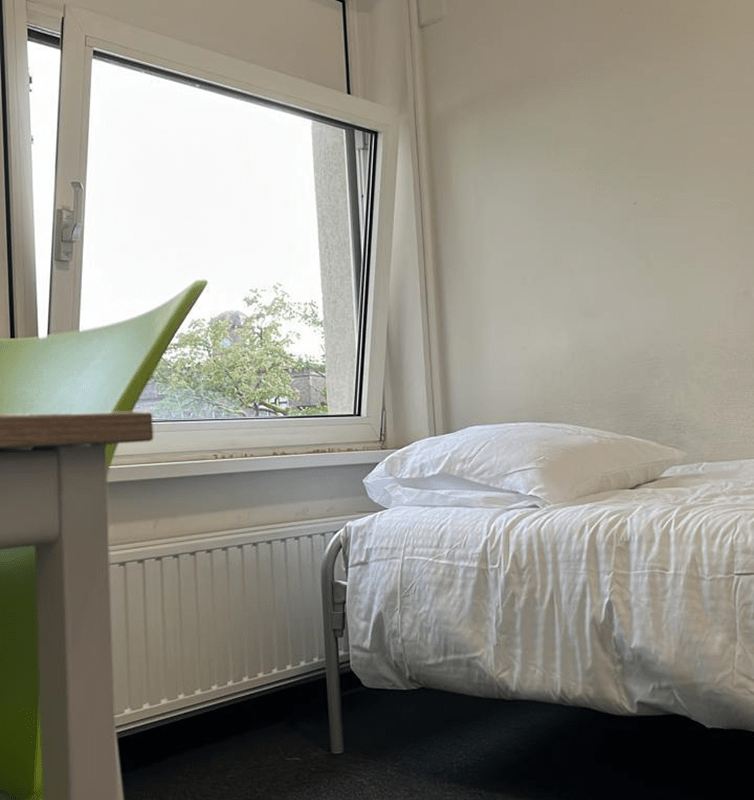
I was placed in Unit 202 on the ground floor, which was perfect since I didn’t need to use the elevator. My room number was 22. When I stepped inside, I instantly liked it. The room felt calm and cozy, with a slanted ceiling and two big windows that let in plenty of natural light. Every morning, the sunlight would flood the room and warm the carpeted floor. It made me feel less homesick.
The room came fully furnished with a single bed, a wardrobe, a desk, a chair, a desk lamp, and even a long power strip. I also had my own heater and a sink with a mirror. It was very convenient for brushing my teeth or washing my face without leaving the room. The bed already came with a pillow, duvet, and sheets. I was also surprised to see the floor was carpeted, unlike most homes in Indonesia. Each unit was provided with a vacuum cleaner for cleaning the carpet.
My unit had seven rooms in total, and only three of us were from Indonesia. It was me and two other IISMA friends. The other housemates came from various countries, including Australia, Mexico, Vietnam, and several parts of Europe. To enter the unit, we had to tap a key-pass that looked like a small guitar pick. Each unit had a different sensor, so we couldn’t just enter other units freely. It felt safe and private. We shared three toilets (one of them accessible for students with disabilities), two bathrooms, a common kitchen, a laundry room, and a dining area with five chairs.
In the kitchen, there was a fridge, a sink, and one stove with an exhaust hood (to absorb cooking smells). Each room had its own kitchen cabinet with a lock and a number, where we stored our cooking ingredients. The shared laundry room had a washer and dryer, and we could use it freely with our own detergent.
The rent was €515[1]per month, including water, electricity, and Wi-Fi. I just needed to transfer the money every month. I didn’t need to worry about individual utility bills or contracts. The tap water was drinkable too, so I didn’t need to buy bottled water. I could refill my bottle straight from the sink in my room.
Sharing a unit with international students was a new experience for me. When I arrived, I didn’t know anyone except my friends from the IISMA program. The first few days were quiet, but since we all used the same kitchen and laundry room, we naturally began interacting. I often cooked with my two Indonesian friends, and we would sometimes share the dining table with other housemates.
Luckily, the people in my unit were very clean and respectful. One student from Australia even bought some cleaning tools herself and posted notes in the kitchen to remind everyone to keep things tidy. Because of that, we never had arguments about dirty dishes or messy counters.
My friend and I also made a WhatsApp group for Unit 202. We created it so we could remind each other about cleanliness and manage the trash disposal schedule. There were three types of waste bins: paper/cardboard, plastic, and organic. We set a weekly trash rotation based on room numbers. For example, on Week 1, the students who occupy Room 16 would take out the trash, and then those in Room 17 for the following week, and so on.
One cultural difference that stood out was how we used the toilet. In Indonesia, most people use a bidet or water to clean up. Here, the toilets only had tissue. That’s why we brought our own portable bidets from home. It was a small adjustment, but an important one for comfort.
Our unit was also mixed-gender, with both male and female students. Because we came from different countries with different habits and food cultures, communication was a key. For example, Indonesian food tends to have strong aromas, so we made it a habit to always turn on the exhaust hood while cooking. That way, everyone could feel comfortable sharing the space.
Over time, I got used to living in this shared environment. It became a small community where we respected each other’s routines and learned to adapt through daily interaction. Living in the dorm taught me how to communicate better, be more tolerant, and appreciate different ways of living.
Studio Apartment Life: Based on My Friend’s Story
A friend of mine from Curaçao, a small island country in the Caribbean near Venezuela, was a full-year international student at Saxion and had a completely different experience. Although she wasn’t part of the IISMA program, we were classmates and eventually became good friends. While I was adjusting to shared kitchens and busy dorm halls, she was settling into her own quiet studio apartment.
She got the studio through a bit of luck. One of her close friends was moving out and recommended her to the landlord. Thanks to that, there were no long applications or interviews. She only needed to show her passport, and the landlord quickly agreed. “It all happened so fast,” she told me. “I barely had time to process it.”
But it wasn’t that simple for her friend, the one who originally rented the place. Since her friend had a job, she had to provide several documents when applying: her salary slip, financial statements from her parents, and a letter from Dienst Uitvoering Onderwijs (DUO), the Dutch education execution service, showing how much financial support she was receiving. In comparison, my friend’s process was much easier.
Her studio was part of a house that had been divided into several small living spaces. From the outside, it looked like a regular Dutch home, but her unit inside was compact and comfortable. There was a window above her desk where sunlight streamed in every morning, warming the wooden floor. Her small kitchen had white cabinets and a mini fridge that hummed quietly in the background. She didn’t have to wait in line or worry about someone else’s dishes. The bathroom was just a few steps away, and the entire space felt calm and personal.
She paid €550 per month, which already included water, electricity, and WiFi. On top of that, she had to pay for a bond, usually about the same as one month’s rent. The bond money would be returned when she moved out, as long as the room was still in the same condition when she moved in.
For her, the cost was worth it. She didn’t have to coordinate meal times or clean up after others. She could play music without headphones, sip tea in peace, and live by her own schedule. The only additional payment she had to handle separately was a government fee related to local services, such as trash collection and water infrastructure.
When I asked her if she had any advice for students looking for accommodation like hers, she said, “Start early, even if you’re still just dreaming about studying here.” She used to refresh housing websites daily and treated it like a mission. Good listings disappeared quickly, sometimes within hours. She said it was important to stay alert, to be flexible with location, and not to be discouraged if a room wasn’t right next to campus. With good bike lanes and public transport, distance wasn’t a big issue.
She also gave one practical tip when dealing with landlords: keep communication simple and clear. If they asked whether she could manage the rent or pay the bond, she just said yes if she could. That made her seem reliable and helped avoid unnecessary doubts.
Looking back, I realized there’s no one “right” way to experience student life abroad. Some students live in shared dorms, surrounded by new friends and the smell of someone else’s cooking. Others enjoy the quiet of a studio, with no roommates or schedules to follow. Both experiences are valid and meaningful.
For me, the dorm was a warm little bubble filled with small daily interactions. It was where I learned how to live with others and discovered the rhythm of Dutch student life. I could also improve my English because I lived with people from different countries. We came from different backgrounds, so we naturally communicated in English every day. For my friend, her studio was a personal sanctuary. It gave her full independence and a space to call her own.
If you’re planning to study in the Netherlands, be open-minded and flexible. Some students get lucky with housing offers, while others spend weeks searching and comparing. Either way, your experience will be shaped not just by where you live, but by how you live.
[1] All the prices mentioned in this article might change because of the currency fluctuations.

 Corners of enschede
Leave a comment