
When I first arrived in the Netherlands through the IISMA program, everything felt unfamiliar. I had just landed in Enschede, a small student city I had never been to before. The buildings looked different, the streets were quiet, and even the way people moved around seemed new to me. As an exchange student, I didn’t know anything yet about how the public transport worked here.
Back in Indonesia, I was used to ordering online rides or using motorbikes to get around. In Enschede, there were buses and trains, and everyone seemed to know exactly what to do, where to tap their cards, which platform to wait on, and which app to check for schedules. I had no idea where to begin. I didn’t even have the public transport card, which everyone seemed to carry.
On the first few days, I started learning by doing. First, I had to travel to Utrecht to take care of my residence permit, so I joined some friends to go there and used a group train ticket. Second, I had to take a local bus to the Twente area for an event where I experienced using the OV-chipkaart for the first time.
These trips introduced me to how the Dutch public transport system worked, from buying tickets to tapping in and out on buses and trains. My first time using the Dutch public transport showed the importance of planning, being on time, and having an OV-chipkaart to get around easily as an international student.
My First Time on the NS Train: Group Ticket Experience
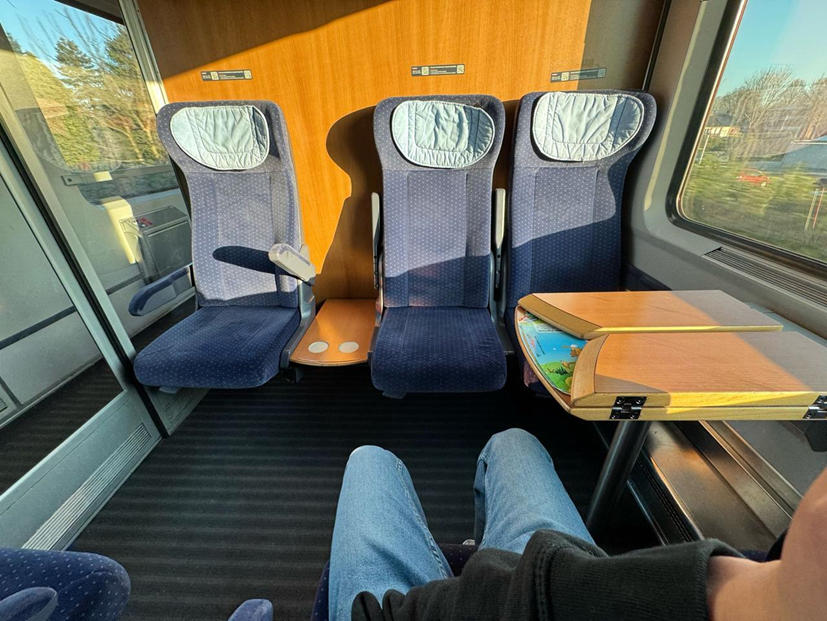
The day after we landed in the Netherlands, we found ourself on a train heading to Utrecht. It was early in the morning. The sky outside was bright blue, and sunlight poured through the window beside us as the train moved past buildings and greenery. We were still adjusting to the cool air, the calmness, and how everything seemed to work like clockwork.
We had to go to Utrecht to arrange our residence permit. Since we hadn’t had our OV-chipkaart yet, we decided to get a group ticket instead. In the Netherlands, Nederlandse Spoorwegen (NS) Train offers a group ticket that can be used for up to seven people to travel together by train at a much cheaper price. It was valid for a round trip on the same day, as long as everyone in the group started and finished the journey together. But there’s a catch: we can only use it during off-peak hours. That meant we had to begin our trip after 9 in the morning and return before midnight. If we missed the train even for a few minutes, the ticket would be useless. That small rule shaped the entire day. The group ticket cost only €15[1] per person for a round trip. It was a great deal compared to the normal €24 for a one-way ticket.
The train was clean and quiet. I sat on a firm blue seat with a light blue headrest cover. The fabric felt smooth but firm, and the seat slowly warmed up beneath me. In front of me, there was a wooden foldable table fixed to the wall. The train smelled fresh and clean, with a subtle hint of antiseptic and the soft scent of freshly cleaned seats. The only sounds were the low rumble of the tracks and the occasional announcement echoing through the speaker. It felt like time was moving a little slower in that space.
Later on, I discovered a subscription of NS Train called Weekend Vrij. It let me travel for free by train to any cities in the Netherlands from Friday evening until Sunday night. The monthly fee was around €30, and with that, I could explore without thinking about ticket costs. For someone who loved weekend trips, it was totally worth it. I signed up through the NS website, which was simple and straightforward. I just needed to make an account, choose the subscription plan, and link it to my OV-chipkaart.
That first train ride taught me more than I expected. It wasn’t just about getting from one place to another. It taught me how the Dutch move. Every trip was timed and every rule was clear. People checked their train schedules the night before, arrived on time, and walked with a purpose. The doors opened and closed exactly when they were supposed to. There was no rushing, no shouting, no confusion. It made me pay attention. It made me learn to think ahead and plan things better. Even something as ordinary as catching a train started to feel like a reminder.

Getting the OV-Chipkaart: Buses and Flexibility
A few days after my first train ride, I finally got my OV-chipkaart. It was a public transport card that I could use for both trains and buses. In Enschede, there were no trams, so I mostly used it for short bus rides around the city. The system was super easy. I just tapped in when I got on, tapped out when I got off, and the total cost was billed at the end of the month through email. It was a pay-later system, which was really convenient.
To get my personal OV-chipkaart, I applied online through the official website. The process was straightforward. I filled out a form with my personal details, uploaded a passport-style photo, and paid a fee of €7.50. The card arrived by mail within a week.
The card itself was yellow, with my name and photo printed on it. It felt sturdy, like a credit card, and had a slight texture on the surface. Holding it in my hand, I could feel the embossed letters of my name. The plastic had a faint new-card smell, a mix of ink and material that reminded me of freshly printed IDs.
Using the card was simple. I would hold it against the card reader when boarding the bus or train, and a soft beep confirmed that I had checked in. The screen displayed a message that said “Incheck OK.” When I got off, I tapped it again, and two beeps signaled that I had checked out successfully. The screen then showed the cost of the journey.
One day, I had to go to the Twente area for an event where I became the MC. The bus station was right in front of the central train station, just a few minutes’ walk from my dorm. I went there with a couple of friends. We took the bus together. Everything went smoothly at first. We tapped in, found our seats, and the bus started moving.
About ten minutes later, I looked over, and my friend whispered, “Are you okay? I feel a bit dizzy.” I laughed and said, “Same. I don’t think my brain is used to all these turns.” We both sat quietly after that, staring out the window, trying to focus on anything that wasn’t moving. The bus ride wasn’t even that long, but for some reasons, it felt like a rollercoaster. We weren’t used to it yet, and it definitely caught us off guard.
Even with the dizziness, everything else worked like clockwork. The bus came on time, followed the schedule exactly, and we made it to the event without any problems. That ride made me realize how important the OV-chipkaart was here. It was not just for convenience. It was a must-have if I wanted to get around and not be stressed about tickets every single time.
Dutch public transport was clean and reliable, and was strongly based on rules. Through both the group ticket and the OV-chipkaart, I experienced the trade-off between flexibility and affordability. Group tickets were great for saving money when traveling with others, but they came with strict time limits. The chipkaart, on the other hand, offered the freedom to travel anytime without worrying about buying tickets, as long as I tapped in and out correctly.
These small rides slowly built my confidence in navigating life in the Netherlands. I learned to check schedules carefully, compare travel options, and make sure I never missed a time restriction. What started as a confusing system turned into a daily routine. Understanding public transport was not just about moving from one place to another, but also about learning to adapt, stay organized, and grow more independent in a new country.
[1] All the prices mentioned in this article might change because of the currency fluctuations.

 Corners of enschede
Leave a comment